
Borneo & Malaysia
 Birding with a Camera (BwC)
Birding, wildlife, photography
We are currently only offering this tour as a Custom Tour. Please Contact Us for more information
This is a Birding with a Camera Tour (BwC). We try to balance seeing as many birds as possible with also trying to take great photos of them. We still target endemics and other specialties. We will also try to see and photograph other animals if any are around; Borneo is a good place for this. If you are looking for a traditional Birding Tour, you should check out our Borneo: Broadbills and Bristleheads tour. Borneo is a photographer’s dream: a large island with steamy jungles and waterways which play host to some of the strangest creatures on Earth. From the “Old Man of the Forest”, or orangutan, to the portly, bulbous-nosed, Proboscis Monkey, to large flashy hornbills with bright-orange casques, and multicolored broadbills, Borneo has plenty to offer. This tour visits the Malaysian state of Sabah in northern Borneo, which features a great circuit of eco-lodges. This tour features several night excursions to search for nocturnal creatures, like flying squirrels, civets, lorises, or tarsiers, as well as visiting a number of blinds targeting rare birds like pittas and partridges.
An extension to mainland Malaysia is available too, visiting one of Asia’s most famous birding locales, Fraser’s Hill for the chance to photograph laughingthrushes, mesias, cupwings, and babblers, among many others that are not possible in Borneo.




Price
From $9925
Length
16 days (21 days w/ extension)
Physical Difficulty
Moderate
Pace
Moderate
Focus
Birding, wildlife, photography
Group size
9 + 1 leader + 1 local guide
Main Tour: 9 – 24 October
$9925; single supplement: $1400
Extension: 24 – 29 October
$3450; single supplement: contact us
Starting City
Kota Kinabalu
Ending City
Kota Kinabalu

After arrival in Sabah’s capital, the sleepy city of Kota Kinabalu, you will be transferred to a local hotel for the night. The tour starts with a welcome dinner on this night.
The first destination of the tour will be the distinctively shaped Mount Kinabalu, which can even dominate the skyline of the capital on clear days. Endemic birds are abundant as we walk the misty mountain trails. We hope to encounter some of the many cool birds that are endemic to the Bornean highlands such as the White-head’s trio: trogon, broadbill and spiderhunter, and some of the many other great birds that are present here. This night will be spent close to the park entrance.
These days will be spent on this scenic mountain. Early mornings around the start of the Summit Trail in particular, can be good for large, photogenic birds like treepies, whistling-thrushes and drongos as they feed on insects attracted to the lights during the night. Thereafter we will hit some of the more challenging trails, walking and birding and hoping for some cooperative trogons, wren-babblers, flowerpeckers, or sunbirds. In the afternoon of day 4 we will travel back to Kota Kinabalu for a night, in readiness for our domestic flight out the next morning.
On this day we’ll take a flight south in order to visit the Danum Valley Conservation Area, where we will stay 3 nights in one of the best lodges in all of Asia, the famous Borneo Rainforest Lodge, perched on the edge of the Danum River, and surrounded by tall, pristine primary rainforest. We will be hoping that some of the large fig trees are bearing fruit at this time, as they can attract some of Borneo’s most famous residents, notably the Red Ape, or Orangutan, as well as an array of fruit-eating birds, such as the dramatic Rhinoceros Hornbill. Three nights will be spent within this fantastic lodge, giving us plenty of time to shoot a variety of subjects in this large conservation area.
Early mornings right around the lodge can be good to take in the resident group of Bornean Crested Firebacks (a stunning pheasant), as they patrol the grounds at this time. At night there will be options to take nightwalks and put your macro to use, as a myriad of rainforest bugs and frogs, such as Wallace’s Flying-Frog, can be found by prowling the jungle with our experienced naturalist guide. There will also be opportunities to take part in one of the famous night drives out of the lodge for larger subjects, such as Thomas’s and Red Giant Flying Squirrels, “Flying Lemur” (Malayan Colugo), or Bearded Pig. During the daytime, your local guide will also use playback to attract in some of the flashier rainforest birds like Black-and-yellow and Black-and-red Broadbills, trogons, or one of the attractive blue-and-red flycatchers that occur in the area, to name but a few. These two nights will again be spent at the Borneo Rainforest Lodge.
From Danum we will travel north, by road, to Sepilok, a tourist center, with great lodges which serve the main tourist attraction nearby, the famous Orangutan rehabilitation center. However, our focus will be the ground-breaking Rainforest Discovery Centre, which comes with wide open trails for easy access to the rainforest for seeing canopy birds and for photography; and a world-class canopy walkway. The latter is the centerpiece of this reserve, which allows eye level views of birds such as hornbills, trogons, kingfishers, woodpeckers, and broadbills. The quality construction of the walkway means that there is plenty of space for enjoying the canopy birds. We will be hoping for some fruiting trees to be present in the area, as these can attract a procession of frugivorous birds, as well as animals like squirrels. The night will be spent in Sepilok, just a few minutes drive from the Rainforest Discovery Centre.
A full day will be spent at the centre so that we have plenty of time to explore the many easy trails, and the canopy walkway, which is the reserve’s most heralded facility. The walls of the restaurant on site are decorated with many fantastic images taken right within the reserve, and illustrates the enormous potential of the place. Another night will be spent in Sepilok.
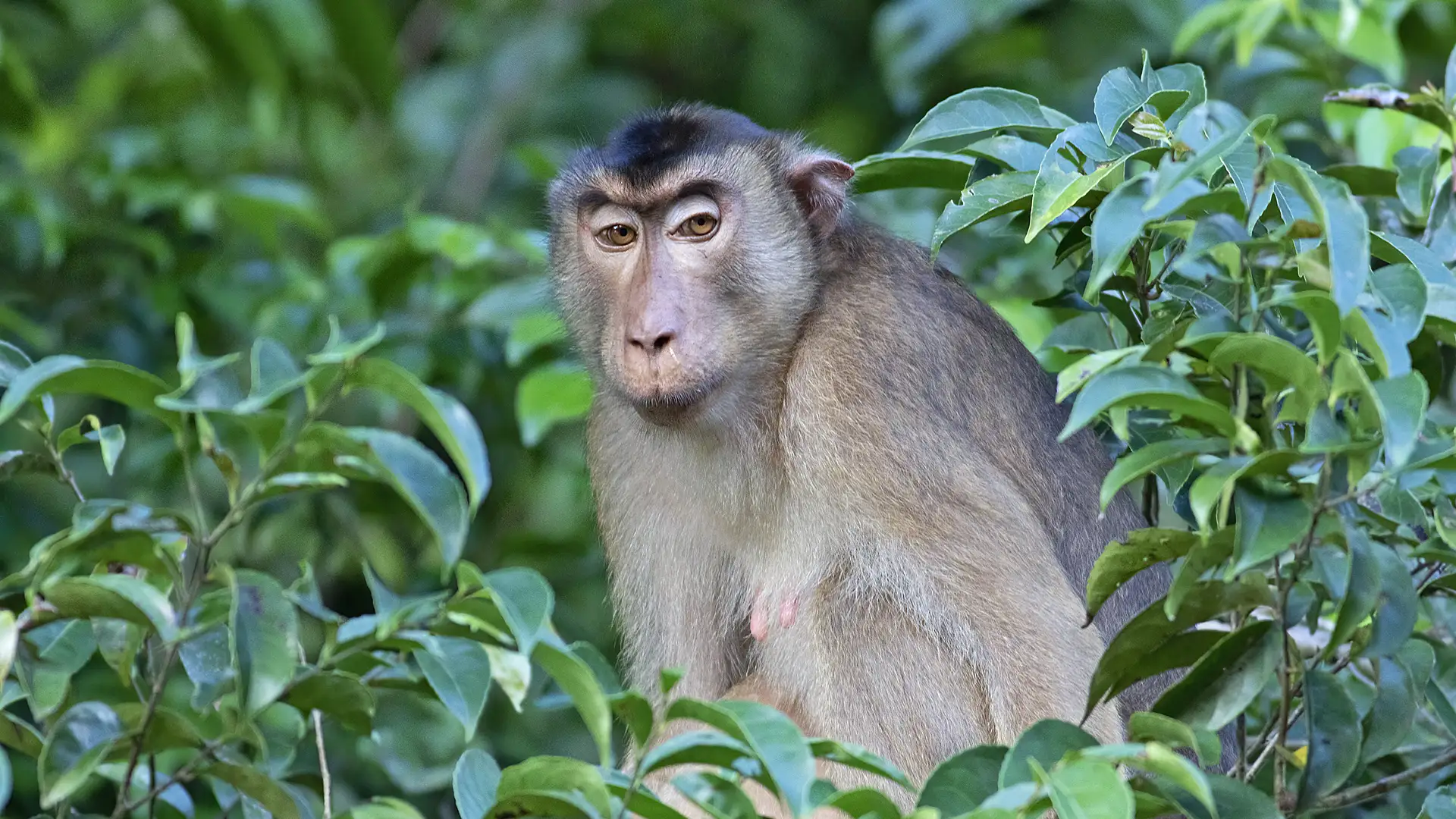
The finale to the tour is perhaps the best part of all; a visit to the primate and bird-rich Kinabatangan Wildlife Sanctuary. The Kinabantangan River is flanked by lowland rainforest, interspersed with ox-bow lakes, mangroves and swamps, and is home to some of the most desirable photo subjects of the tour: Orangutan, Proboscis Monkeys,and Crab-eating and Pig-tailed Macaques, as well as all 8 species of Bornean hornbills. This is also the best area on the island for the amazing and rare Bornean Pygmy-Elephant. We will be staying at a high-end lodge, right on the banks of this enormous river. The choice of lodge has been made not only for the comfort of the lodge, which has won a number of eco-tourism awards, but also for the transport available. We will be mostly traveling around by motorized canoe to traverse the various waterways in the sanctuary. The canoes crucially though, come equipped with smaller electronic motors to allow a quiet approach when needed, vital when on a photography tour to get those incredible, intimate close-ups of subjects such as Proboscis Monkey families, a Blue-eared Kingfisher fishing along the river bank, or a fish-eagle standing sentry above. At night, there will also be the option to take a night cruise to search for roosting birds such as Stork-billed Kingfishers, and photograph the local Buffy Fish-Owls, which are surprisingly abundant and approachable near the lodge. We will travel into the lodge by speedboat.
Two full days will be spent coasting the waterways of within the Kinabatangan Wildlife Sanctuary, tracking down both the many avian, and mammalian, targets in the area. There will be options to go out at night too for further night cruises (there may be an extra fee for this). On one afternoon we shall visit the Gomantong Caves, home to millions of bats, and thousands of nesting swiftlets, which use echolocation, like bats, in order to navigate within the dark recesses of the caves. We will wait until dusk on this day to ensure we take in the awesome sight of the emerging “funnel” of bats, which often fall prey in these photogenic moments to a handful of waiting Bat Hawks.
Although we will have come in to the Kinabatangan by boat, for the exit from there we shall drive out, passing again by Gomantong Caves, which shall give us another chance for a final session there, so that we can try to connect with the various hornbills, barbets, broadbills, and other birds, as well as animals such as Red Leaf-Monkey and Pig-tailed Macaque. Thereafter we shall pack up and drive to the city of Sandakan, to connect with a short domestic flight west across Borneo back to Kota Kinabalu on the west coast, where you can then connect with international flights out.
Day 1: Arrival in Kota Kinabalu (Sabah, Borneo)
After arrival in Sabah’s capital, the sleepy city of Kota Kinabalu, you will be transferred to a local hotel for the night. The tour starts with a welcome dinner on this night.
Day 2: Kota Kinabalu to Tambunan
A very early start (04:00am) will be required to reach a blind near Tambunan, in the Crocker Range. This particular blind has become famous for attracting a wonderful selection of birds. Most famously, it is the most reliable site to see the rare Bulwer’s Pheasants. We will, however, need some luck to see a full-tailed male, as they are only occasional visitors in this season. However, the blind is also fantastic for seeing Crested Partridge, a true cartoon bird that is extremely hard to see away from here. If we had no luck with Red-breasted Partridge the day before, this blind will also provide further chances at this, and if luck is on our side we may also pick up Bornean Banded-Pitta there too. Other species that may come to the blind include Asian Emerald Dove, Penan Bulbul, Sunda Scimitar-Babbler, Bornean Black-capped and Temminck’s Babblers, Orange-headed Thrush, Dayak Blue Flycatcher, and Siberian Blue Robin. The forested areas nearby are home to Bornean Barbet, Pygmy Heleia, Black-capped White-eye, Temminck’s Sunbird, Chestnut-crested Yuhina Verditer Flycatcher, and Bornean Leafbird. A single night will be spent in Tambunan.
Day 3: Gunung Alab to Mount Kinabalu
In the morning, we will visit a magnificent feeding station in the foothills of the Crocker Range, at Gunung Alab. Much of the morning will be spent there, trying to shoot birds at the various feeding areas, like Crimson-headed and Red-breasted Partridges, Golden-naped Barbet, Plume-toed Swiftlet, Bornean Shortwing, White-browed Shrike-Babbler, Chestnut-hooded Laughingthrush, and Indigo and Little Pied Flycatchers. In the afternoon, we will drive to a base just outside of Mount Kinabalu, in Kundasang, for a three-night stay.
Day 4: Mount Kinabalu
A full day will be spent on this scenic mountain. It is home to many endemics, though the photography will be on the fly, as there are no feeding areas within the park. Among the birds we will be hoping for are Whitehead’s Trogon and Whitehead’s Broadbill, which are both regular though neither are guaranteed. Other species of interest include Pale-faced Bulbul, Bornean Whistling-Thrush, Bornean Whistler, Black-sided Flowerpecker, and Mountain Black-eye. Sometimes, early in the morning, Everett’s Thrush can be found feeding along the road. We will try on both of our morning’s there as this can be a good way to pick up shy birds that feed in the open at this time, that could also include Eyebrowed Jungle Flycatcher. While Borneo’s marquee mammals are largely confined to lowland areas, Borneo and its highlands are rich in squirrels, and we will be hoping to find the minute “Whitehead’s Squirrel” or Tufted Pygmy Squirrel, one of the smallest squirrels in the world, which is the size of a goldfinch.
Day 5: Doromomol Bird Hide and Mount Kinabalu
In the morning, if recent local news is good on this, we visit a new blind for Blue-banded Pitta. This will involve a very early morning departure (around 04:00am). After a morning in that area (if the news is good), we will revisit Mount Kinabalu. If the pitta is not coming during our visit, we will simply spend another full day on Mount Kinabalu.
Day 6: Mount Kinabalu to Telupid
After a final morning in the park, we will head east to Telupid for a one-night stay.
Day 7: Peacock-pheasant Blind to Sepilok
In the morning, we will visit a very special place indeed, a blind that regularly attracts the very rare and local Bornean Peacock-Pheasant. We will keep our fingers crossed that this spectacular bird cooperates during our visit, as even here, sightings are never guaranteed. In the afternoon we will head to Sepilok, visiting the famous Rainforest Discovery Centre. We will have some time at the groundbreaking Rainforest Discovery Centre area on this afternoon and the following morning. It boasts wide-open trails and a world-class canopy walkway for easy access to the rainforest. On this day we will linger in the forest after our afternoon walk to take a night walk with an experienced local guide, taking a late dinner after this. At dusk we may see Red Giant Flying Squirrels emerge from their roosting hollows, while during the walk we may find roosting birds like Rufous-backed Dwarf-Kingfisher, and if we are lucky a Horsfield’s Tarsier, a real-life Gremlin that is our main night mammal target in the area.
Day 8: Sepilok to Gomantong Caves and Sukau
Much of the morning will be spent at the Rainforest Discovery Centre in Sepilok. The walls of the restaurant on site are decorated with many fantastic images taken right within the reserve and illustrate the enormous potential of the place. Among the possibilities within the reserve are Sabah Partridge, Raffle’s Malkoha, Wallace’s Hawk-Eagle, Diard’s Trogon, Black and Oriental Pied Hornbills, Brown and Black-eared Barbets, White-bellied Woodpecker, Black-and-yellow and Black-and-red Broadbills, Green Iora, Fiery Minivet, Charlotte’s and Cream-vented Bulbuls, and a variety of sunbirds. In the afternoon, we will visit Gomantong Caves. This is home to millions of bats, and thousands of nesting swiftlets (three species that can only reliably identified by observing their nests), which use echolocation, like bats, in order to navigate within the dark recesses of the caves. We will wait until dusk on this day to ensure we take in the awesome sight of the emerging “funnel” of bats, which often fall prey in these photogenic moments to a handful of waiting Bat Hawks. After that we will travel by car and canoe to a lodge in the banks of the mighty Kinabatanga River, where we will stay for 3 nights.
Days 9-10: Lower Kinabatangan Wildlife Sanctuary (Sukau area)
We will have two full days in the primate and bird-rich Lower Kinabatangan Wildlife Sanctuary. The Kinabantangan River is flanked by lowland rainforest, interspersed with ox-bow lakes, mangroves and swamps, and is home to some of the most desirable photo subjects of the tour: Bornean Orangutan, Proboscis Monkeys, and Crab-eating and Pig-tailed Macaques, and it is also a known hotspot for hornbills in particular, with species like Rhinoceros, Wrinkled, Bushy-crested, White-crowned and Oriental Pied Hornbills all occurring there. This is also the best area on the island for the rare Bornean Pygmy-Elephant; if they are present in the sanctuary during our visit, we will go straight there! (They wander widely and can sometimes be outside of the public viewing areas). We will be staying at a good lodge, right on the banks of this enormous river for three nights. We will be mostly traveling around by private motorized canoe to traverse the various waterways in the sanctuary. The canoes come equipped with smaller electronic motors to allow a quiet approach when needed, vital when on a photography tour to get those incredible, intimate close-ups of subjects such as Proboscis Monkey families, a Blue-eared Kingfisher fishing along the riverbank, a Western Hooded Pitta calling from the understory, or a fish-eagle standing sentry above. At night, there will also be the option to take a night cruise on one night to search for roosting birds such as Stork-billed Kingfishers, and the local Buffy Fish-Owls, which are surprisingly abundant and approachable near the lodge.
Day 11: Kinabatangan Hide to Mount Silam and Lahad Datu
In the morning we will visit another blind where we will be hoping for Bornean Crested Fireback, Sabah Partridge and Bornean Black-capped Babbler. After this final time in the Kinabatangan River area, we will drive to Mount Silam, where we hope to find the extremely local, Scarlet-breasted Flowerpecker. Other species that can be found there, include Whiskered Treeswift, Banded Kingfisher, Red-throated Barbet, Green Broadbill, Ventriloquial Oriole, Blyth’s Paradise-Flycatcher, Rufous-tailed Shama, Gray-chested Jungle-Flycatcher, and Little Spiderhunter. A night will be spent in the town of Lahad Datu.
Day 12: Lahad Datu to Danum Valley
On this day, we will drive two hours to Danum Valley, one of the most revered sites in Bornean birding. We will arrive in time start birding the area. Three nights will be spent at a lodge in Danum Valley, and on two of these nights there will be the option to go out on night walks, in search of nocturnal animals after dinner, where a macro lens may come in handy for bugs and frogs.
Days 13-14: Danum Valley
Two full days, and a morning will be spent in the Danum Valley area, not only targeting the many spectacular birds of the region but some marquee mammals too. We will be enlisting the help of expert local guides on our quest for endemic birds and other animals. At the top of the list will be the “Red Ape” or Bornean Orangutan, and if there are any large fig trees in fruit during our visit, we have a good chance at tracking down this iconic Bornean animal down. It is not the only mammal of interest either, as Maroon Leaf-Monkey and North Bornean Gray Gibbon also occur in the local forests. While the birding and photography in these forest is difficult, the rewards are fantastic; birds like Bornean Bristlehead, Black-crowned and Blue-headed Pittas, Black-and-yellow and Banded Broadbills, and a series of dramatic hornbills can be found there, including the iconic Rhinoceros Hornbill with its bloated, tangerine-colored casque. Other spectacular birds in the area include Scarlet-rumped and Red-naped Trogons, and a multitude of babblers. We will need to work for our birds, as birding in these forests is famously challenging, though the list of birds makes this well worthwhile. We will be staying in a new, very nice lodge for our three-night stay in this area where mammals and birds will compete for our attention.
Day 15: Danum Valley to Kota Kinabalu
On this day we will journey from Danum Valley to Kota Kinabalu. We will hope to take a domestic flight out of Lahad Datu to Kota Kinabalu. However, if the schedules do not allow this, we will need to make an all-day drive to reach our destination. We will endeavor to get the flights though when possible. The final night of the tour will be spent in Kota Kinabalu.
Day 16: Departures/start Malaysian Peninsula Extension
If you are not joining the extension, you are free to fly out at any time you wish, as there are no activities planned on this day. If you are joining the extension, you will fly out on this day to Kuala Lumpur and then drive to Bukit Tinggi.
This extension starts and ends in the Malaysian capital, Kuala Lumpur, on Peninsula Malaysia, which connects directly with Kota Kinabalu in Borneo for the main tour. Being based on the Peninsula and visiting one of the best mountain birding areas in all of Southeast Asia, this extension offers some very different birds to see and photograph, with many of these species only possible on the extension. Similarly, many of the birds and animals on Borneo are only possible or likely on the main tour (e.g. Bornean Orangutan, Proboscis Monkey, Maroon Leaf-Monkey, and Bornean Crested Fireback), making these sections perfect compliments to one another.
Day 1: Arrival in Kuala Lumpur; to Bukit Tinggi
After arrival in Malaysia’s capital, we will transfer you to a hotel located in the cool highlands of Bukit Tinggi, a two-hour drive from the airport.
Day 2: Bukit Tinggi to Fraser’s Hill
An early morning start will be needed to visit a forest feeding area for our two principal targets, the rare Mountain Peacock-Pheasant and stunningly-adorned Ferruginous Partridge. By mid-morning we will depart this popular resort area for the tranquil setting of Fraser’s Hill. This area has been a long-favored hangout for both birders and keen photographers alike. It is common on weekends to meet Malaysian photographers perusing the area, on the hunt for the latest photo-ops. We should arrive at Fraser’s Hill by lunchtime, when we will check into a hotel for a four-night stay right beside where the birds are.
Days 3-5: Fraser’s Hill and The Gap
A good road network both on the top of the hill itself, and at the bottom around “The Gap” allows easy access to forest birds right from the road. The roads on the hill weave their way past gardens that attract birds like Streaked Spiderhunter, Chestnut-capped Laughingthrush, the spectacular Silver-eared Mesia, and Fire-tufted Barbet. There are plenty of avian subjects to keep us busy on the hill, including Red-headed Trogon, Orange-bellied Leafbird, Black-throated Sunbird, and Golden Babbler. Cruising the road down to The Gap offers us chances of lower elevation species such as hornbills like Wreathed Hornbill, as well as a chance to bump into flocks that could hold exciting birds like Sultan Tit and Long-tailed Sibia. Down at “The Gap” itself, the nature of the forest changes, as it becomes wetter and more humid and birds like Rufous Piculet, Black-crested Bulbul, and a series of barbets become possible, especially if one of the large figs is in fruit.
Day 6: Fraser’s Hill to Kuala Lumpur/DEPARTURES
After some final few hours around Fraser’s Hill, we will drive back to Kuala Lumpur in time to take evening flights out.
PACE: Moderate. Early starts are necessary (typically around 6:00 am) on most days since we need to take advantage of the best light and bird activity, and we also will be active in late afternoons and evenings where possible. On only a handful of days will there be downtime in the middle of the day, (when it is often hot, and the birds are less active). Most of the drives on the main tour are only around 2 hours, save for one possible all-day drive between Danum Valley and Kota Kinabalu, if flights are no available (we will try and get domestic flights where possible). On the Malaysia Peninsula Extension, there is one long drive of around around 4 hours from Fraser’s Hill to Kuala Lumpur airport at the end of the extension. There are several packed breakfasts required, two on the main tour, and on the second day of the extension in particular.
PHYSICAL DIFFICULTY: Moderate. At Mt. Kinabalu and Danum Valley there is a lot of walking involved, on roads and hilly forest trails – you should be prepared to walk 3-4 miles (5-6km) on some days (with your camera gear). Along the Kinabatangan, we will be in boats much of the time, which does not require much physical exertion. On the extension it is a bit easier as we will spend a lot of time on flatter open roads or using the vehicle to look for fruiting trees and other good locations.
CLIMATE: Hot and humid at Sepilok, Sukau and Danum (mostly 74°-88°F, 23°-31°C) and very humid, but cool on Mount Kinabalu and on the extension at Fraser’s Hill (mostly 50°-68°F, 10°-20°C). Gunung Alab and Trus Madi will be somewhere between these two main areas in terms of climate. Rain is likely as Borneo in particular is wet year-round. This is most often in the afternoons in the form of thunderstorms, but one can also have tropical systems that create rain for longer periods.
ACCOMMODATION: Good to excellent. Sabah is one of the best-developed areas is Asia for eco-tourism. Most accommodations have private, en-suite bathrooms, full-time hot water, and 24-hour electricity. The one exception will be in Danum, where the power will be operated via generator at night, and runs in solar power by day. The accommodations used on the Peninsula Extension are good.
TRAVEL REQUIREMENTS: A valid passport is required; the passport must be valid for at least six months past your intended stay and have at least one blank page. Visas are not currently required for citizens of the US, Canada, the UK, Europe, Australia, New Zealand, and South Africa. However, all tourists must complete the Malaysia Digital Arrival Card (MDAC) within 3 days of arrival, which can be found HERE. Visas are currently required only of a few nationalities, mainly in Africa and the Middle East. Travel requirements are subject to change; it’s always a good idea to double check six weeks before the tour, or ask our office for help
WHAT’S INCLUDED?: Tips to drivers, local guides and lodge staff; accommodation from the night of day 1 to the night of day 15 if taking only the main tour, and to the night of day 5 of the extension if also taking that too; meals from dinner on day 1 (unless you arrive too late for dinner service) to breakfast on day 16 if taking only the main tour, and to lunch on day 6 of the extension if also taking the extension; safe drinking water throughout; Tropical Birding tour leader from the evening of day 1 to the afternoon of day 15 if taking only the main tour, if taking the extension please request more info from our office regarding guiding arrangements; one arrival and one departure airport transfer per person on arrival and departure day respectively (transfers may be shared with other participants of the same tour if they are on the same flight); ground transport for the group to all sites in the itinerary from day 2 to day 15 (and to day 6 of the extension if also taking the extension) in a suitable vehicle; entrance fees to birding sites, parks and reserves mentioned in the itinerary; several boat trips on the Kinabatangan River at Sukau; domestic flights in Borneo on day 15 if schedules allow (between Kota Kinabalu and Lahad Datu).
WHAT’S NOT INCLUDED?: Optional tips to the Tropical Birding tour leader; tips for luggage porters (if you require their services); international flights; domestic flight between Borneo and Peninsula Malaysia (if you are joining the extension); snacks; additional drinks apart from those included; alcoholic beverages; travel insurance; excursions not included in the tour itinerary; extras in hotels such as laundry service, minibar, room service, telephone calls, and personal items; medical fees; excess baggage charges; other items or services not specifically mentioned as being included.
After arrival in Malaysia’s capital, we will transfer you to a hotel outside of Kuala Lumpur located in the cool highlands of Bukit Tinggi.
An early morning start will provide a fantastic introduction to the birds of the region. While our main targets will be the famous Mountain Peacock-Pheasants and Ferruginous Partridges that frequent the area, we will also take time to check the impressive botanical gardens for any mixed flocks or fruiting trees. By mid-morning we will depart this popular resort area for the tranquil setting of Fraser’s Hill. This area has been a long-favored hang out for both birders and keen photographers alike. It is common at weekends to meet a handful of Malaysian photographers perusing the area, on the hunt for the latest photo opps; a growing community of which exist within the country. By lunchtime we will check into the wonderful Smokehouse Inn, the most comfortable lodgings on the mountain, which are akin to an old English inn, and which comes equipped with a garden full of blooming shrubs that my just attract some of the birds we are hoping to see shoot. Four nights well be spent on the mountain.
A good road network both on the top of the hill itself, and at the bottom around “The Gap” allows easy access to forest birds right from the road. The roads on the hill weave their way past gardens which attract birds like Streaked Spiderhunters, Chestnut-capped Laughingthrushes, and Fire-tufted Barbets. There are plenty of avian subjects to keep us busy on the hill, including exciting possibilities such as Red-headed Trogon, Silver-eared Mesia, Orange-bellied Leafbird, Black-throated Sunbird, Red-bearded Bee-eater, and Golden Babbler. Cruising the road down to The Gap offers us chances of lower elevation species such as hornbills like Rhinoceros and Great, as well as a chance to bump into flocks that could hold exciting birds like Sultan Tit and Long-tailed Sibia. Down at The Gap itself, the nature of the forest changes, as it becomes wetter and more humid and birds like Rufous Piculet, Black-crested Bulbul, and a series of barbets become possible, especially if one of the large figs is in fruit.
After a final few hours around Fraser's Hill or The Gap, we will drive to Kuala Lumpur and take a mid afternoon flight to Kota Kinabalu in Borneo for the start of the main tour.
Want to learn more? Fill this form and we’ll be in touch.


Reviews
There are no reviews yet.