
Japan
 Birding
We are currently only offering this tour as a Custom Tour. Please Contact Us for more information
Japan – the clean-cut, modern economic powerhouse – is also an archipelago that is as variable as it is exciting. From the subtropics of Kyushu to temperate Hokkaido, the stark mountains, jagged coastline, and forests hold several of the world’s must-see birds. This tour runs in winter, when the massive-billed Steller’s Sea-Eagles congregate on impressive ice floes waiting for fishermen’s scraps, and huge numbers of cranes gather at their wintering grounds. Add some great mixed-flock birding in the coniferous forests of the central islands, in addition to gulls and waterbirds galore, and you have a great mix of birding experiences. Another great experience is indulging in some sake (a pungent and strong white spirit) on a cold winter night while waiting for the Blakiston’s Fish-Owl (one of the World’s largest owls) at a floodlit waterhole stake-out. You will leave these enigmatic islands having experienced some of the greatest birding spectacles on earth. On this trip, we spare no expense, including three pelagic outings on our main tour, an important consideration when comparing this to other Japan tours.




Price
From $6995
Length
14 days (up to 21 days w/ extensions)
Physical Difficulty
Easy
Pace
Moderate
Focus
Birding
Group size
12 + 2 leaders
Main Tour: 17 January – 30 January
$6995; single supplement: $850
Ryukyu Pre-Extension: 11 – 17 January
$3380; single supplement: $490
Pelagic Post-Extension: 30 – 31 January
$975; singles not available
Main Tour: 16 January – 29 January
$7295; single supplement: $850
Ryukyu Pre-Extension: 10 – 16 January
$3490; single supplement: $510
Pelagic Post-Extension: 29 – 30 January
$975; singles not available
Starting City
Tokyo
Ending City
Tokyo

The tour starts with a 10:00am meeting at a Narita Tokyo airport Hotel, from where we travel to the Karuizawa area for a two night stay, and where we’ll begin our Japanese birding in earnest. Nestled on the slopes of the impressive Asamayama volcano, we’ll scour the snow-dusted forests for our first birds, including the remarkable Varied and cute Long-tailed Tits, Oriental Greenfinch and maybe our first endemics in the form of Japanese Green and Japanese Pygmy Woodpeckers. If we are lucky we might even see some transient species such as Long-tailed Rosefinch, Pale Thrush, or the striking Meadow Bunting. We spend two nights in Karuizawa.
The woodlands here support some superb birds, the finest ones being the endemic Copper Pheasant and immaculate Japanese Waxwing. As we search the quiet forest trails and streams looking for these we hope to encounter the mighty Crested Kingfisher, Brown Dipper, Japanese Wagtail, Japanese Grosbeak, and Hawfinch.
We head to the amazing Snow Monkeys first thing this morning, where we enjoy them in the steam baths with icicles forming on their snow-matted fur. Then we head to Komatsu for a two-night stay.
Honshu’s western coastline is a waterfowl paradise and we seek out some great rarities here amongst a swathe of common waterfowl. Katano Kamoike is a small sanctuary that holds Baikal Teal, Bewick’s Swan and both Taiga and Tundra Bean Geese. We may also see Falcated Duck, Greater White-fronted Goose and others today.
On this day we fly via Tokyo to the island of Hokkaido, Japan’s Alaska, where we spend the next five days. Huge tracts of taiga-like mountainous wilderness, covered in snow and ice fields make this the most visually stunning part of Japan. While bird species diversity is low in this barren icy seascape, it supports some of the world’s must-see birds including the spectacular, gargantuan Steller’s Sea-Eagle. We spend two nights in Nemuro.
This area provides some of the most exciting and varied winter birding in Japan, with a good diversity of species. This morning we indulge in a pelagic trip off this finger of land where we hope to get great views of alcids like Least Auklet, Spectacled and Pigeon Guillemots and Ancient Murrelet. We’ll go as far as Cape Nosappu where the oceans are sometimes packed with sea ducks and gulls including Common Goldeneye and scoters, and cormorants. Red-throated Loon and Red-necked Grebe are also specialty species in this vicinity.
Today we scour the coastline and capes looking for sea ducks and alcids, including Black and White-winged Scoters, Harlequin Duck and Long-tailed Duck, and hopefully some rarer species like Spectacled Guillemot, Ancient Murrelet or Crested Auklet. The day should also yield an amazing gull-fest including the likes of Glaucous and Glaucous-winged gulls. We finish off the day in a forested valley where we will wait eagerly near a fishpond for one of the ultimate birds of the tour – the massive Blakiston’s Fish-Owl. We spend two nights in Rausu.
Today’s boat trip is phenomenal. We head out between the ice rafts into a massive ice-sea. While gulls abound, we’ll mostly be on the lookout for eagles. We’ll notice the size difference between the already impressive White-tailed and simply gigantic Steller’s Sea-Eagles. These chocolate-and-white leviathans are crowded on the ice at times, and when our boatman starts throwing out fish scraps, they wheel in and gorge themselves within a few meters of the boat, offering unbelievable photographic opportunities. This evening we will try again for the temperamental Blakiston’s Fish-Owl if last night’s vigil proved luckless.
We will leave the Rausu area, and if we have time, we may stop in at Kiritappu, a great site for seawatching and Asian Rosy Finch, before arriving at Akan for the night. In the afternoon we will visit the Akan Crane Centre which is in easy walking distance of our lodge. We will have chances to photograph dozens of Red-crowned Cranes gather in the white powder snow to dance and bugle in an unforgettable nuptial display. We will overnight in Akan.
We’ll fly back to Tokyo (Haneda) and then on to Kagoshima on the southern island of Kyushu, which is bordering on subtropical. We head to the town of Izumi, home to the most impressive gathering of cranes in the world, for a two night stay.
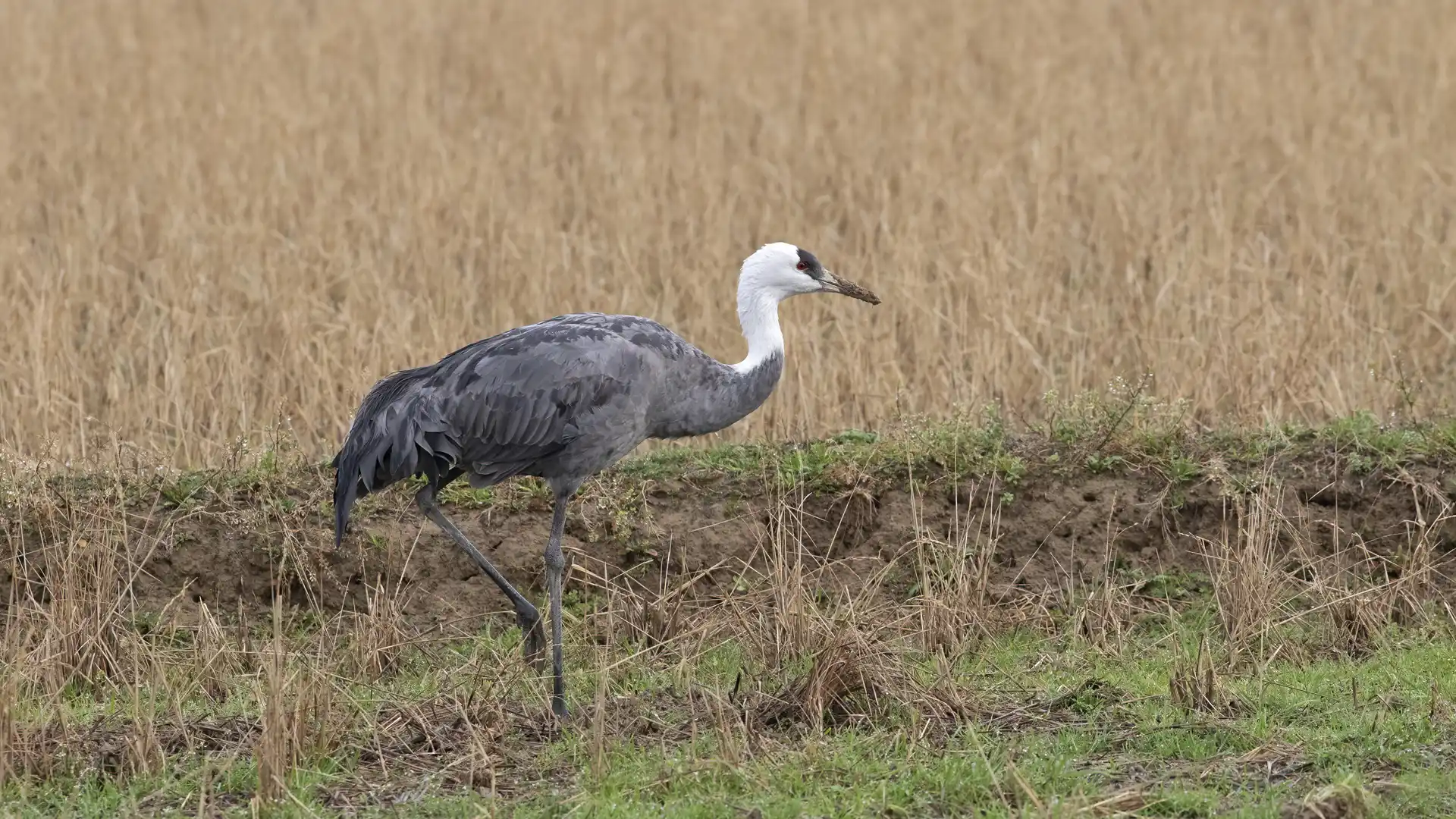
This morning we will be blown away by one of the most awesome birding spectacles on Earth; a gathering of more than 10,000 cranes. The cacophony of bugling crane calls will be heard seemingly right outside our rooms, in darkness before we have even left our beds. Regal White-naped Cranes join the more abundant Hooded Cranes, and by scouring these flocks of extremely elegant birds we may pick out a few Common or Sandhill cranes, or if we are really lucky a vagrant Demoiselle or ghostly Siberian Crane. After this overwhelming experience we’ll tap into a variety of other habitats in the region. The coast may yield Temminck’s Cormorant and the scarce Saunder’s Gull. Fields and meadows should reveal buntings and pipits, and perhaps the verdant Green Pheasant. Rivers will be scoured for one of the world’s toughest shorebirds, Long-billed Plover, while Japanese Bush-warblers skulk in the riparian thickets.
After a final morning at Izumi, we will head to Mi-ike where we will overnight. On clear days we’ll see the impressive volcanic cone looming large in the background, while birds such as Ryuku Minivet, White-bellied Green Pigeon, Mountain Hawk-Eagle, Gray Bunting, White-backed Woodpecker and Japanese Grosbeak may thrill us in the foreground. We’ll also visit a lake where we search for some rare waterbirds, chiefly the incredible Mandarin Duck amongst the many common ducks. We will overnight in Kirishima.
We will take a boat trip out to Kadogawa Harbor to search for Japanese Murrelet. While out there, we may also encounter Vega, Black-tailed, and Slaty-backed Gulls, Great Crested Grebe, or Pacific Reef Heron. In the afternoon we will explore the Miyazaki coastline and check an estuary for the endangered Black-faced Spoonbill. We will overnight in Sadowara.
After some final birding in the area, the main tour finishes today with a flight back to Tokyo. If you are not joining the extension, you may connect with international flights home. Those staying for the extension will head for the ferry terminal.
Day 1: Tokyo to Karuizawa
The tour starts with a 10:00am meeting at a Narita Tokyo airport Hotel, from where we travel to the Karuizawa area for a two-night stay, and where we’ll begin our Japanese birding in earnest. Nestled on the slopes of the impressive Asamayama volcano, we’ll scour the snow-dusted forests for our first birds, including the remarkable Varied and cute Long-tailed Tits, Oriental Greenfinch and maybe our first endemics in the form of Japanese Green and Japanese Pygmy Woodpeckers. If we are lucky, we might even see some transient species such as Long-tailed Rosefinch, Pale Thrush, or the striking Meadow Bunting. We spend two nights in Karuizawa.
Days 2: Karuizawa
The woodlands here support some superb birds, the finest ones being the endemic Copper Pheasant and immaculate Japanese Waxwing. As we search the quiet forest trails and streams looking for these, we hope to encounter the mighty Crested Kingfisher, Brown Dipper, Japanese Wagtail, Japanese Grosbeak, and Hawfinch.
Day 3: Karuizawa to Nagano and Komatsu
We head to the amazing “Snow Monkeys” (Japanese macaques) first thing this morning near Nagano, where we enjoy them in the steam baths with icicles forming on their snow-matted fur. Then we head to Komatsu for a two-night stay.
Day 4: Western Honshu Wetlands
Honshu’s western coastline is a waterfowl paradise, and we seek out some great rarities here amongst a swathe of common waterfowl. Katano Kamoike is a small sanctuary that holds Baikal Teal, Tundra Swan and both Taiga and Tundra Bean Geese. We may also see Falcated Duck, Greater White-fronted Goose and others today too.
Day 5: Honshu to Hokkaido
On this day we fly via Tokyo to the island of Hokkaido, Japan’s Alaska, where we spend the next five days. Huge tracts of taiga-like mountainous wilderness, covered in snow and ice fields make this the most visually stunning part of Japan. While bird species diversity is low in this barren icy seascape, it supports some of the world’s must-see birds including the spectacular, gargantuan Steller’s Sea-Eagle. We spend two nights in Nemuro.
Day 6: Nemuro Peninsula
This area provides some of the most exciting and varied winter birding in Japan, with a good diversity of species. This morning we indulge in a pelagic trip off this finger of land where we hope to get great views of alcids like Least Auklet, Spectacled and Pigeon Guillemots and Ancient Murrelet. We’ll go as far as Cape Nosappu where the oceans are sometimes packed with sea ducks and gulls including Common Goldeneye and scoters, and cormorants. Red-throated Loon and Red-necked Grebe are also specialty species in this vicinity.
Day 7: Notsuke Peninsula to Rausu
Today we scour the coastline and capes looking for sea ducks and alcids, including Black and Stejneger’s Scoters, Harlequin Duck and Long-tailed Duck, and hopefully some rarer species like Spectacled Guillemot, Ancient Murrelet or Crested Auklet. The day should also yield an amazing gull-fest including the likes of Glaucous and Glaucous-winged Gulls. We finish off the day in a forested valley where we will wait eagerly near a fishpond for one of the ultimate birds of the tour – the massive Blakiston’s Fish-Owl. We spend two nights in Rausu.
Day 8: Rausu sea trip
Today’s boat trip is phenomenal. We head out between the ice rafts into a massive ice-sea. While gulls abound, we’ll mostly be on the lookout for eagles. We’ll notice the size difference between the already impressive White-tailed and simply gigantic Steller’s Sea-Eagles. These chocolate-and-white leviathans are crowded on the ice at times, and when our boatman starts throwing out fish scraps, they wheel in and gorge themselves within a few meters of the boat, offering unbelievable photographic opportunities. This evening we will try again for the temperamental Blakiston’s Fish-Owl if last night’s vigil proved luckless.
Day 9: Rausu to Akan
We will leave the Rausu area, and if we have time, we may stop in at Kiritappu, a great site for seawatching and Asian Rosy Finch, before arriving at Akan for the night. In the afternoon we will visit the Akan Crane Centre which is within easy walking distance of our lodge. We will have chances to photograph dozens of Red-crowned Cranes gather in the white powder snow to dance and bugle in an unforgettable nuptial display. We will overnight in Akan.
Day 10: Akan to Izumi
We’ll fly back to Tokyo (Haneda) and then fly on to Kagoshima on the southern island of Kyushu, which is bordering on subtropical. We head to the town of Izumi, home to the most impressive gathering of cranes in the world, for a two-night stay.
Day 11: Izumi
This morning we will be blown away by one of the most awesome birding spectacles on Earth; a gathering of more than 10,000 cranes. The cacophony of bugling crane calls will be heard seemingly right outside our rooms, in darkness before we have even left our beds. Regal White-naped Cranes join the more abundant Hooded Cranes, and by scouring these flocks of extremely elegant birds we may pick out a few Common or Sandhill cranes, or if we are really lucky a vagrant Demoiselle or ghostly Siberian Crane. After this overwhelming experience we’ll tap into a variety of other habitats in the region. The coast may yield Temminck’s Cormorant and the scarce Saunder’s Gull. Fields and meadows should reveal buntings and pipits, and perhaps the verdant Green Pheasant. Rivers will be scoured for one of the world’s toughest shorebirds, Long-billed Plover, while Japanese Bush-warblers skulk in the riparian thickets.
Day 12: Izumi to Mi-ike
After a final morning at Izumi, we will head to Mi-ike. On clear days we’ll see the impressive volcanic cone looming large in the background, while birds such as Ryuku Minivet, White-bellied Green-Pigeon, Mountain Hawk-Eagle, Gray Bunting, White-backed Woodpecker and Japanese Grosbeak may thrill us in the foreground. We’ll also visit a lake where we search for some rare waterbirds, chiefly the incredible Mandarin Duck amongst the many common ducks. We will overnight in Kirishima
Day 13: Mi-ike to Kadogawa
We will take a boat trip out to Kadogawa Harbor to search for Japanese Murrelet. While out there, we may also encounter Vega, Black-tailed, and Slaty-backed Gulls, Great Crested Grebe, or Pacific Reef Heron. In the afternoon we will explore the Miyazaki coastline and check an estuary for the endangered Black-faced Spoonbill. We will overnight near Miyazaki.
Day 14: Kyushu to Tokyo
After some final birding in the area, the main tour finishes today with a flight back to Tokyo. If you are not joining the extension, you may connect with international flights home. Those staying for the extension will head for the ferry terminal.
We begin in Okinawa, which has a totally different feel than the rest of the country. The Ryukyu islands were formerly part of an independent Ryukyu Kingdom until 1879, when they were annexed by Japan. However, they are both culturally and biologically unique, with about 9 endemic species and 7 additional taxa that could well be endemic species in the future. After exploring both the main island plus the unique island of Amami Oshima in search of their many endemics, we will fly to Tokyo to begin the main tour.
Day 1: Naha
We begin the tour with lunch in Naha, the prefectural capital of Okinawa. Okinawa is the most tropical of Japan’s prefectures and home to some great endemics. On Okinawa’s ‘honto’, or main island, our main targets will be the rare Okinawa Rail and Okinawa Woodpecker. To search for these, we will head to the north of the island and the Yanbaru area which gives the rail its Japanese name, yanbaru-kuina. We will drive along the idyllic coastline before arriving at our well-situated lodge for a two-night stay.
Day 2: Okinawa
The stunning Okinawa Rail, remarkably only first described to science in 1981, is quite common in northern Okinawa, but still considered endangered due its population size of less than 1000 individuals and threats such as the conversion of habitat to golf courses and predation by feral cats. The other extreme rarity is the maroon Okinawa Woodpecker, which has a total population in the low hundreds. We will have a full day to explore this fascinating area in search of our target Okinawa Rail and Okinawa Woodpecker and will also hope for other local specialties including Okinawa Robin and Japanese Paradise Flycatcher. At this time of year we may also pick up one or two late migrants that pass through the Ryukyu island chain. At night we will take an ‘owl-prowl’ in search of Northern Boobooks, and Ryuku and Japanese Scops-Owls.
Day 3: Okinawa to Amami
After our final birding here we will drive south to Naha where we will board our flight to Amami-Oshima, one of the most northerly of the Ryukyu Islands that actually lies in Kagoshima prefecture. Amami is a small island but home to three endemic bird species: Lidth’s Jay, Amami Woodcock, and Amami Thrush. The latter is thought to number only 60-100 individuals. In addition, an endemic race of White-backed Woodpecker is considered by some to be full species: Owston’s Woodpecker. Three nights will be spent on the island of Amami.
Day 4-5: Amami Oshima
We have two full days to explore this lush forest laden with enormous tree ferns, in search of our many targets. The maroon-and-sapphire Lidth’s Jay will be a welcome sight, as will the slew of cross-island endemics such as Ryukyu Green-Pigeon, Ryukyu Flycatcher, Ryukyu Minivet, Ryukyu Robin, and Ryuku Scops-Owl. We will also be sure to look for the many distinct subspecies that could well be split in the near future. We will spend some time at night on Amami looking for the incredible endemic Amami Woodcock and the weird, marsupial-like Amami Black Rabbit.
Day 6: Amami to Tokyo
After a final spot of birding in search of any remaining targets, we will board our flight to Tokyo where we will spend the night.
Day 7: Begin main tour
Well depart the hotel after breakfast and head to the airport to meet the people arriving for the start of the main tour.
Day 1: Tokyo to Miyake-jima
From Tokyo, we will take one of the regular ferries that service the Izu Islands. The ferry goes overnight, and we will spend the night on the boat.
Day 2: Miyake-jima
At dawn, we will disembark on the island of Miyake-jima and spend the morning exploring the forested slopes for Izu Thrush, Japanese Wood-Pigeon and Izu Robin, amongst others. After midday, we will re-board the boat returning from Hachijo-jima and spend the last few hours sea-watching on the most productive stretch of the ferry ride. We hope to see several albatross species which are regular in these waters, especially the rare Short-tailed Albatross. Laysan and Black-footed Albatrosses, Streaked Shearwater, and Black-legged Kittiwakes are all mouth-watering possibilities, and there is always the chance of picking up a serious rarity. After a full afternoon searching for these ocean wanderers, we’ll dock at Tokyo, where we’ll return to Haneda for outward bound flights. If your flight schedule requires an overnight, we can help you book a hotel.
PACE: Moderate. Relatively early starts are necessary on some days (as early as 5:30am), such as when watching the cranes awaken at Tsuruimura & Arasaki. Because there are only about nine hours of daylight in mid-winter, there will not be much downtime during daylight hours, but there is usually plenty of time to relax during the long nights. The driving isn’t too bad on this trip, with drives of four or more hours on about two days of the trip, and mostly on very good roads. Most meals will be in restaurants, but several breakfasts and lunches will be bought at convenience stores as this gives us a lot more flexibility and saves valuable daylight birding time. These convenience stores offer a surprisingly good variety of food too.
PHYSICAL DIFFICULTY: Easy to moderate. Some of the birding will be from the car. Most of the walking will be on flat or slightly inclined roads or wide tracks although there will be some longer walks along narrower forest trails at Mi-ike & Karuizawa. Due to snowy and icy conditions, suitable footwear is required and walking sticks and crampons are highly recommended. All walks are done at a slow pace. The longest walk is the 2.5-mile (4 km) roundtrip walk to see the Snow Monkeys, which has some inclined sections and some steps, but anyone with a reasonably good level of fitness can handle it.
CLIMATE: It will be cold and often snowy for most of the trip, so good quality cold weather gear is essential. The coldest part of our tour will be in Hokkaido, where temperatures range from 7 – 32F (-14 – 0C). The Shiretoko Peninsula there belongs to the same subarctic zone as Russia and Canada, and this is winter! Hats, gloves and a very warm jacket, and waterproof clothing are all essential. It can also be sunny but still cold and this is when sunscreen and lip protection are recommended. The ice and snow can be slippery so a good pair of walking boots or even snow boots are recommended. Crampons and walking sticks are also essential for the icy conditions. The pull-on crampons with small studs are best, rather than spikes, so they can be removed easily when in the vehicles. Kyushu is the mildest place we will visit on this tour, with temperatures ranging from about 39° to 56°F (4° to 13°C). Blizzards are possible in some areas, and there is a chance of road closures, possibly causing on-the-spot changes to the itinerary.
ACCOMMODATION: We will stay in two distinctly different types of accommodation on this tour: Typical western style accommodation with private bathrooms, and Japanese style Minshukus (primarily in Hokkaido and usually four nights total). The Minshukus are normally large, shared rooms for 2 or 3 people. The bathrooms are large, shared bathrooms. There is some etiquette about the use of such bathrooms, and we will discuss this at the start of the tour. Minshukus do not have single accommodations available, and the single supplement for this tour has been calculated based only on the accommodations where we can provide single rooms. We use the Minshukus because they are located at some of the best birding localities, and some of their owners are birders that supply excellent local information. They also provide a distinct and unique Japanese ‘flavor’ to the tour, and most people really enjoy the experience of staying in them.
PHOTOGRAPHY: This is a birding tour, but casual photographers will have great opportunities to photograph birds, Snowy Monkeys, and scenery. Photo opportunities on Hokkaido are particularly good. We should have a boat trip from Rausu to see Steller’s Sea-Eagles and White-tailed Eagles on the ice flow (if the ice has arrived). We should also have great opportunities to photograph Red-crowned Cranes waking in the Setsuri River and dancing on the snow at their feeding sites. Please bear in mind that all of these are weather dependent. There are feeders at our lodge at Karuizawa and Nemuro although we will watch these through glass. We often get good shots of birds such as ducks and gulls in the harbors of Hokkaido. Serious bird photographers may wish to check out our Japan Photo Tour, which we currently run as a custom tour.
WHEN TO GO: This tour has been timed for the Japanese winter, when the birds and scenery are arguably at their most dramatic. At this time of year, more than ten thousand of cranes come to winter together on the island of Kyushu, while also there are large gatherings of Red-crowned Cranes on the island of Hokkaido. This is also the time of year when eagles come to winter in good numbers in Rausu on the same island, including the huge Steller’s Sea-Eagle. Being wintertime, it is also good for flocks of wintering waterfowl which are also targets for this tour, and this is also a good season for seeing some of the key seabirds we are seeking on the various pelagic boat trips. The icy landscapes are also at their most photogenic at this time of year. Japan in spring and summer is also very good, though a completely different tour, with different targets, which we can run as a custom tour.
TRAVEL REQUIREMENTS: A valid passport is required for entry into Japan. It must be valid for at least 6 months past the time of your scheduled return and have at least one blank page. Currently, visas are not required for citizens of the US, Canada, the UK, Western Europe, Australia, and New Zealand. For other countries, please check your nearest embassy or consulate for current requirements, or ask us for help. All tourists must submit a customs form on arrival. This can be done in advance at this Visit Japan website. This makes things quicker when you arrive. Travel requirements are subject to change; it is a good idea to double check several weeks before the tour. It is a good idea to bring with you photocopies of your passport and visa pages within your passport, keeping them separate from your passport while on the tour.
WHAT’S INCLUDED?: Accommodation from night of day 1 to the night of day 13 of the main tour, (from the night of Day 1 to the night of Day 6 of the Ryukyu Pre-Extension, if taking that too; accommodation aboard a passenger ferry on the night of Day 1 of the Pelagic Post-Extension if taking that); meals from lunch on day 1 to lunch on day 14 of the main tour (from lunch on Day 1 to breakfast on Day 7 of the Ryukyu Pre-Extension if taking that too, from dinner on board the ferry on Day 1 of the Pelagic Post-Extension to lunch on Day 2 of that extension, if joining that too; extra drinking water when needed throughout, including within vehicles (the tap water is generally safe to drink at most places in Japan); Tropical Birding tour leader with scope and playback gear from the morning on day 1 to the afternoon of day 14 on the main tour (from the morning of Day 1 to the morning of Day 7 of the Ryukyu Pre-Extension if taking that too, from the afternoon of Day 1 to the afternoon of Day 2 on the Pelagic Post-Extension to lunch on Day 2 of that extension, if joining that too; airport transfers if on the dates specified; ground transport for the group to all sites in the itinerary from the morning of Day 1 to the evening of Day 14 (the tour leader usually is the driver) on the main tour; ground transport on the Ryukyu Pre-Extension too from the morning of Day 1 to the afternoon of Day 6 (the guide also drives on this); all domestic flights specified on the main tour, (and the Ryukyu Pre-Extension if taking that too); return tickets on an overnight ferry for the Pelagic Post-Extension of taking that too; 3 boat trips on the main tour (conditions permitting) in Rausu, Nemuro and Kadogawa; entrance fees to all sites specified in the itinerary; a printed and bound checklist to keep track of your sightings (given to you at the start of the tour – only electronic copies can be provided in advance).
WHAT’S NOT INCLUDED?: Optional tips to the tour leader; tips for luggage porters if you require their services; international flights; excess luggage charges on any of the domestic flights (limits on these are 1 check in bah up 44lbs/20kg and 1 carry-on of 7kg/15lbs); snacks; additional drinks apart from those included; alcoholic beverages; travel insurance; excursions not included in the tour itinerary; extras in hotels such as laundry service, minibar, room service, telephone calls, and personal items; medical fees; other items or services not specifically mentioned as being included; expenses that could arise due to circumstances beyond Tropical Birding’s control (weather, flight delays/cancellations, lost luggage, road closures, etc).
We begin in Okinawa, which has a totally different feel than the rest of the country. The Ryukyu islands, were formerly part of an independent Ryukyu Kingdom until 1879, when they were annexed by Japan. But they are both culturally and biologically unique, with about 9 endemic species and 7 additional taxa that could well be endemic species splits. After exploring both the main island plus the unique island of Amami Oshima in search of their many endemics, we will fly to Tokyo to begin the main tour.
We begin the tour with lunch in Naha, the prefectural capital of Okinawa. Okinawa is the most tropical of Japan’s prefectures and home to some great endemics. On Okinawa’s ‘honto’, or main island, our main targets will be the rare Okinawa Rail and Pryer’s or Okinawa Woodpecker. To search for, these we will head to the north of the island and the Yanbaru area which gives the rail its Japanese name, yanbaru-kuina. We will drive along the idyllic coast line before arriving at our well situated lodge for a two-night stay.
The stunning Okinawa Rail, remarkably only first described to science in 1981, is quite common in northern Okinawa, but still considered endangered due its population size of less than 1000 individuals and threats such as the conversion of habitat to golf courses and predation by feral cats. The other extreme rarity is the maroon Pryer’s Woodpecker, which has a total population in the low hundreds. We will have a full day to explore this fascinating area in search of our target Okinawa Rail and Pryer’s Woodpecker and will also hope for other local specialties including Okinawa Robin and Japanese Paradise Flycatcher. At this time of year we may also pick up one or 2 late migrants that pass through the Ryukyu island chain. At night we will take an ‘owl-prowl’ in search of Northern Boobooks, and Elegant and Japanese Scops-Owls.
After our final birding here we will drive south to Naha where we will board our flight to Amami-Oshima; one of the most northerly of the Ryukyu Islands which actually lies in Kagoshima prefecture. Amami is a small island but home to 2 endemic bird species: Lidth’s Jay and Amami Woodcock. In addition, endemic races of White-backed Woodpecker and Scaly Thrush are considered by some to be full species: Owston’s Woodpecker and Amami Thrush; the latter is thought to number only 60-100 individuals.
We have two full days to explore this lush forest laden with enormous tree ferns, in search of our many targets. The maroon-and-sapphire Lidth’s Jay will be a welcome sight, as will the slew of cross-island endemics such as Ryukyu Green-Pigeon, Ryukyu Flycatcher, Ryukyu Minivet, Ryukyu Robin, and Elegant Scops-Owl. We will also be sure to look for the many distinct subspecies that could well be split in the near future. We will spend some time at night on Amami looking for the incredible endemic Amami Woodcock and the weird marsupial-like Amami Black Rabbit.
After a final spot of birding in search of any remaining targets, we will board our flight to Tokyo where we will spend the night.
Well depart the hotel after breakfast and head to the airport to meet the people arriving for the main tour.
From Tokyo, we will take one of the regular ferries that service the Izu Islands. The ferry goes overnight, and we will spend the night on the boat.
At dawn, we will disembark on the island of Miyake-jima, and spend the morning exploring the forested slopes for Izu Thrush, Japanese Wood-Pigeon and Izu Robin, amongst others. After midday, we will re-board the boat returning from Hachijo-jima and spend the last few hours sea-watching on the most productive stretch of the ferry ride. We hope to see several albatross species which are regular in these waters, especially the rare Short-tailed Albatross. Laysan and Black-footed Albatrosses, Streaked Shearwater, and Black-legged Kittiwakes are all mouth-watering possibilities, and there is always the chance of picking up a serious rarity. After a full afternoon searching for these ocean wanderers, we’ll dock at Tokyo, where we’ll return to Haneda for outward bound flights. If your flight schedule requires an overnight, we can help you book a hotel.
Want to learn more? Fill this form and we’ll be in touch.

Glenn C. –
A fantastic tour to Japan in Winter with Tropical Birding! Great Guide Charley Hesse, we saw all target birds including Steller’s Sea-Eagles, Blakiston Fish-Owl and the rare Ross’s Gull. Excellent Food and Hotels and Lodges. An excellent tour couldn’t have been better!
Tyler H. –
Amazing Tour with an Amazing Guide. Charley Hesse Introduced us not just to the amazing birds, but to the food and culture of Japan. Charley’s extensive knowledge of the country allowed us to find many rarities off the main Japanese birding routes.
Yvonne H. –
Japan in winter is an incredible destination. This is a fast-paced tour that covers many different areas of Japan. The tour covers many habitats, all with their own unique species of birds, mammals and landscapes. The morning with the snow monkeys was amazing, the boat trip to see the Steller Sea Eagles was fantastic and the Blakiston’s Fish Owl was a major highlight. Charley is very knowledgeable of Japanese culture and the wildlife we saw, and his fluency in the language was extremely helpful. He is clearly passionate about birding and sharing that experience with his guests. Ben was always happy to share photography advice and was helpful to many of us trying to get that “perfect shot”. Charley & Ben worked great together and always made sure everyone was able to get on a bird or animal. Although a birding tour, we spent time observing some great mammals, and had some interesting cultural breaks visiting several shrines & temples. The pelagic extension was a wonderful experience starting with leaving Tokyo harbor at night and enjoying all the city lights to sighting several much-wanted short-tailed albatross during the return ferry crossing.
Hadie Muller –
This was an amazing trip! I was mainly after the cranes and we got all possible cranes. The rest was just icing on the cake – the macaques, the fish owl, the eagles, the Amami rabbit. Having Charley who knows the language and the culture as well as the birds was great.